
Innovation thrives at intersections
Innovation is often linked to technology or brilliant individuals working alone. But research shows a different truth: the most transformative ideas are born when diverse perspectives collide.
According to Harvard Business Review, diverse teams are 45% more likely to grow market share and 70% more likely to capture new markets. When different disciplines meet—architecture, design, technology, art—unexpected solutions appear.
This isn’t new. From the Renaissance, where artists and scientists shared studios, to the cafés of the 20th century where writers and philosophers debated world-changing ideas, history reminds us that creativity flourishes in the in-between.
The role of collaborative workspaces today
Research shows that the body’s natural circadian rhythm responds not only to light, but also to habitual sensory cues—the sound of boiling water, the scent of herbs, the rhythm of slowed breath. Evening rituals work because they signal to our nervous system: “it is safe to let go.”
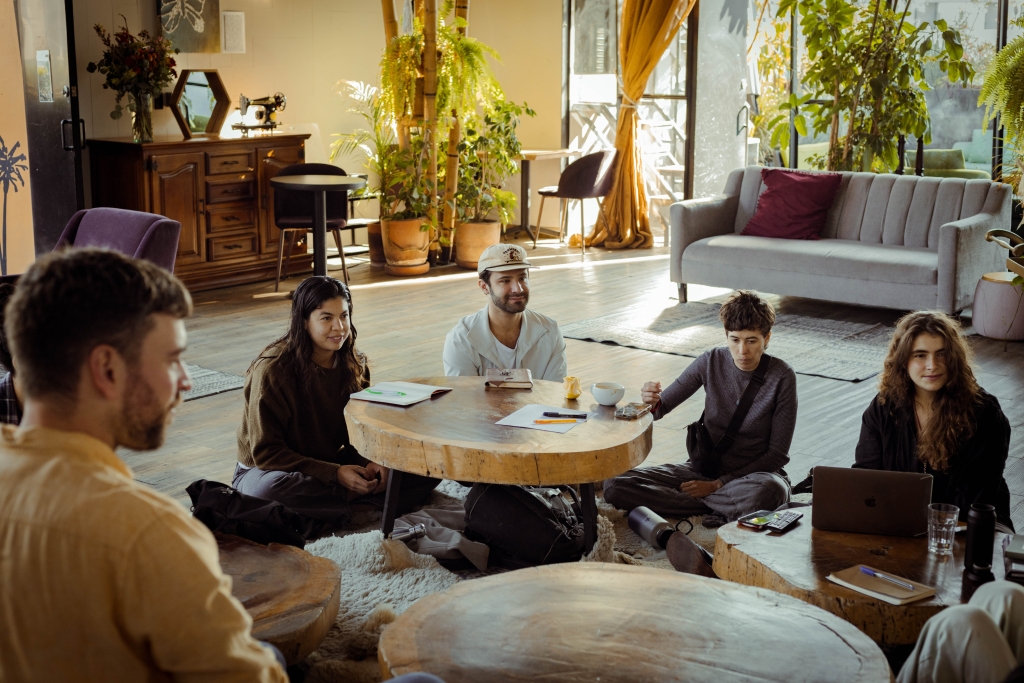
In Mexico City, at HAAB we became one of these hubs, bringing together entrepreneurs, designers, architects, and musicians. Members describe it as a space where collaboration turns into growth:
I didn’t want a conventional office anymore; I was looking for a collaborative one. Arriving at HAAB, we realized we could combine efforts and achieve bigger projects.” — Michel Rojkind, Rojkind Arquitectos
“HAAB has been an incredible community. I love the people who are part of this multicultural space, full of creatives who are driving change in the city.” — Mario Gonzalez, Co-Founder Ice Coldture
“HAAB has been a place where our team can gather, have creative sessions, do some team building and make sure we are all on the same page.” — Emilio Bailon, Akampa
These voices echo what research proves: diversity is not just a value—it’s an engine of innovation.
Why communities accelerate innovation
Beyond infrastructure, what really drives innovation is the human ecosystem. Creative communities provide:
- New perspectives through cultural and professional diversity.
- Unexpected solutions through informal encounters.
- A sense of belonging that motivates individuals and teams to go further.
When people from different industries share a common space, they not only work—they learn, connect, and co-create.
Conclusion: Designing spaces for collisions
The role of leaders and organizations today is not just to generate ideas, but to create the conditions where ideas meet and evolve together.
Because the most powerful innovations don’t come from one discipline alone:
they emerge where ideas collide.
--------------------
👉 Looking for a creative community in Mexico City that blends coworking with culture, design, and collaboration?
Explore our membership options at HAAB and experience how innovation happens when ideas collide.